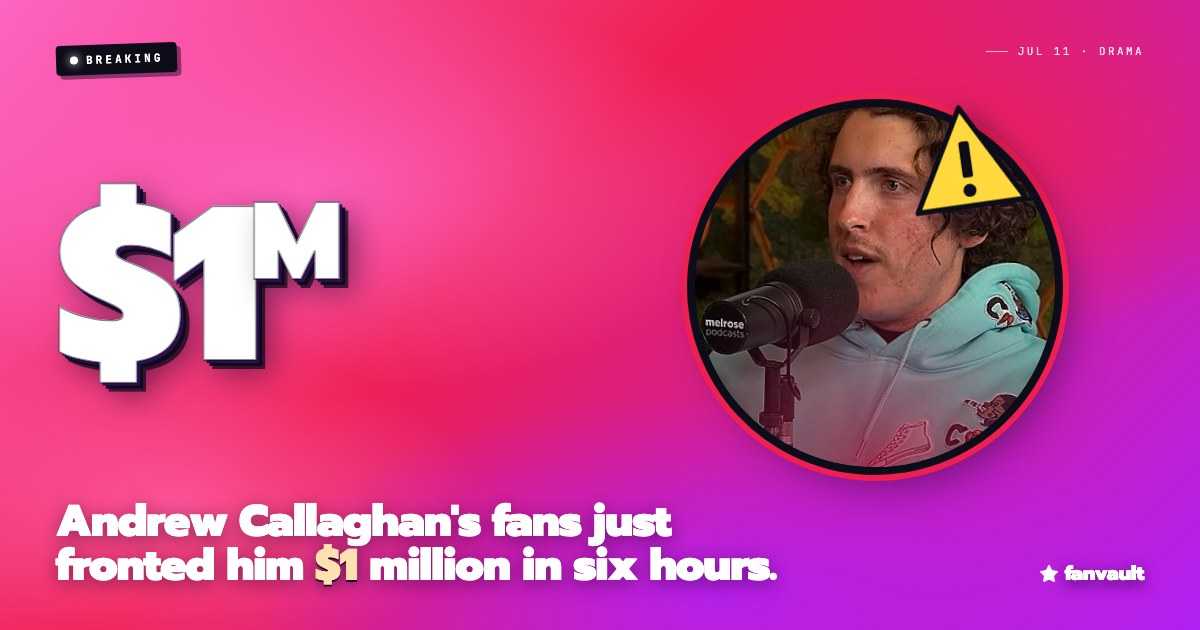
Andrew Callaghan asked his audience for $800,000 on Thursday afternoon to keep Channel 5 alive through a second lawsuit. The goal cleared in about three hours; six hours in, more than 28,000 donors had pushed the fund past $1 million. By Friday it was $1.2 million. A mid-size YouTuber just replaced a media company's legal insurance with a viral link.
⚡ Key Takeaways
- Channel 5's audience funded a legal defense faster than most insurance carriers cut checks: $800K goal in 3 hours, $1M in 6, $1.2M by day two.
- 28,000+ donors replaced what a decade ago would have required a rich patron, a media parent, or a press-freedom nonprofit; that math used to be impossible.
- The plaintiff is the same California lender who already sank two years and roughly $800K of Channel 5's money into a federal wiretap suit that ended in a joint dismissal without prejudice.
- Callaghan's 2023 sexual misconduct allegations resurfaced within hours; the audience knew and still gave, by 1.5x the ask inside a day.
- Direct fan capital is now behaving like litigation insurance across the ecosystem: Noah Samsen's Klein v. Samsen fund and Frogan TV ran the same play before Channel 5 did.
- At Fanvault's 8% platform fee, 92 cents of every donor dollar would stay with the creator; that is the whole point of the direct-to-fan model.
What actually happened?
On July 9, California lender William Joiner served Channel 5 with a new complaint in California state court alleging defamation, stalking, false light, and trespassing. Joiner had already sued once, filing a federal case in May 2024 under the Federal Wiretap Act after seeing the trailer for the Channel 5 documentary Dear Kelly. That case ran nearly two years, and Callaghan says defending it cost Channel 5 north of $800,000 before both sides walked away in a joint stipulation of dismissal without prejudice on May 19, 2026.
Dear Kelly, released in January 2025, was Channel 5's first independently produced feature documentary, following Kelly Johnson (aka Kelly J. Patriot), a QAnon supporter Callaghan first met at a 2021 White Lives Matter rally in Huntington Beach. Johnson's public feud with Joiner over a foreclosed multi-million-dollar home is the beating heart of the film. Joiner has never conceded that framing.
On July 10, Callaghan posted a 24-minute YouTube video titled "We're Being Sued" and launched a GoFundMe with an $800,000 goal, exactly the amount the first lawsuit had already burned. It cleared in roughly three hours. Within six, near $1 million from over 28,000 donors. Channel 5 has about 3.48 million YouTube subscribers, so this is not a top-of-ecosystem outlier, it is a mid-size independent creator.
Why does this matter for creators?
Because a mid-size independent creator just raised more than a well-funded plaintiff's likely legal budget in an afternoon, without an ad partner, a publisher, a studio, or a PR firm in the loop. The audience did it directly. That is a live proof point on where cultural authority sits in 2026, and it is not with the platforms hosting the content.
When 28,000 people average roughly $35 apiece and fund a real-world defense that would have needed a press-freedom nonprofit endowment ten years ago, the leverage math changes for everyone who used to hold it. Plaintiffs, agencies, and the platforms creators post on all lose a little grip. Audience capital is starting to look less like a distribution metric and more like an operating balance sheet.
The old model priced independence as a luxury: you either had a rich patron, a media parent, an insurance carrier, or you shut up. The new model prices it as a subscription your fans already pay. Channel 5 just proved a mid-size YouTube channel can absorb a seven-figure legal shock the same week it lands, because the audience is the endowment.
"We cannot afford to keep operations running here at Channel 5 unless we can immediately fundraise the legal fees."
Andrew Callaghan, founder of Channel 5, in his July 10 YouTube video "We're Being Sued"
Where does this go from here?
Callaghan is not the only creator running this play in 2026. Noah Samsen's Klein v. Samsen defense fund pulled more than $45,000 in twenty hours toward a $200,000 goal after Ethan Klein sued him. Other creators including Frogan TV have gone the same route. Direct fan capital is now behaving like litigation insurance.
The story is not clean, which is the other half of the lesson. Callaghan's 2023 sexual misconduct allegations have resurfaced in the coverage, and Primetimer's headline captured the backlash bluntly: "He deserves prison, not your money." The audience knew, and picked the creator anyway by roughly 1.5x the ask inside a day. That does not resolve the ethics; it resolves the leverage question.
Watch two things next: whether the state court accepts Joiner's amended defamation, stalking, false light, and trespassing claims after the federal wiretap theory got dropped, and whether the fundraise total keeps compounding past $1.5 million, past $2 million, past whatever number stops looking like fandom and starts looking like a mid-market cause. The line between the two is where the next decade of independent creator media gets drawn.
What does Fanvault think?
The Callaghan moment is the direct-to-fan thesis compressed into an afternoon: when the audience is the moat, the platform's only real job is to keep as much of every dollar moving from fan to creator as possible, and to give creators the tools to convert one viral fundraise into an ongoing revenue base. Fanvault is built on that math. Our 8% platform fee means creators keep 92% of every dollar their fans send, and the storefront, memberships, wishlists, tips, paid DMs, and authenticated memorabilia are there so a moment like this compounds into a decade of income instead of a single check that clears and disappears. That is the point of building an AI-native creator platform in 2025: less friction, fewer middlemen, more of the money staying where the audience meant it to go.
The old gatekeepers used to say creators needed them for exactly the moments Callaghan just handled without them. Twenty-eight thousand people said otherwise, in six hours, with a link.
Frequently Asked Questions
Why is Channel 5 being sued for a second time?
California lender William Joiner is the antagonist of Channel 5's January 2025 documentary Dear Kelly, which follows QAnon supporter Kelly Johnson's public feud with Joiner over a foreclosed home. Joiner first sued Channel 5 and Andrew Callaghan in May 2024 in federal court under the Federal Wiretap Act, and that case was jointly dismissed without prejudice on May 19, 2026, with each side eating its own legal fees. On July 9, 2026, Joiner refiled in California state court with an amended set of claims: defamation, stalking, false light, and trespassing.
How much has the Channel 5 GoFundMe raised so far?
Callaghan launched the campaign on July 10, 2026 with an
Why does a creator legal defense fund matter for the wider creator economy?
It is the clearest live proof yet that direct audience capital can substitute for traditional financial backing when an independent creator faces an existential legal risk. Ten years ago, defending a mid-size independent news channel against a well-funded litigant required a media parent, a press-freedom nonprofit, or a rich patron. In 2026, 28,000 individual fans averaging around $35 apiece did the same job in an afternoon. When that math becomes routine, plaintiffs, platforms, and agencies all lose leverage over independent creators.
Have other creators raised legal defense funds this way?
Yes, and the pattern is accelerating in 2026. Noah Samsen's Klein v. Samsen defense fund, launched after Ethan Klein sued him, pulled more than
Does the backlash over Callaghan's 2023 allegations change what the fundraise means?
It complicates the ethics, not the leverage math. Callaghan's 2023 sexual misconduct allegations resurfaced immediately, and Primetimer ran a headline reading "He deserves prison, not your money." Even so, the fundraise cleared 1.5x its stated goal inside 24 hours from a documented, engaged audience, a real receipt on who actually holds cultural authority in 2026 whether or not any given observer agrees with how they used it.